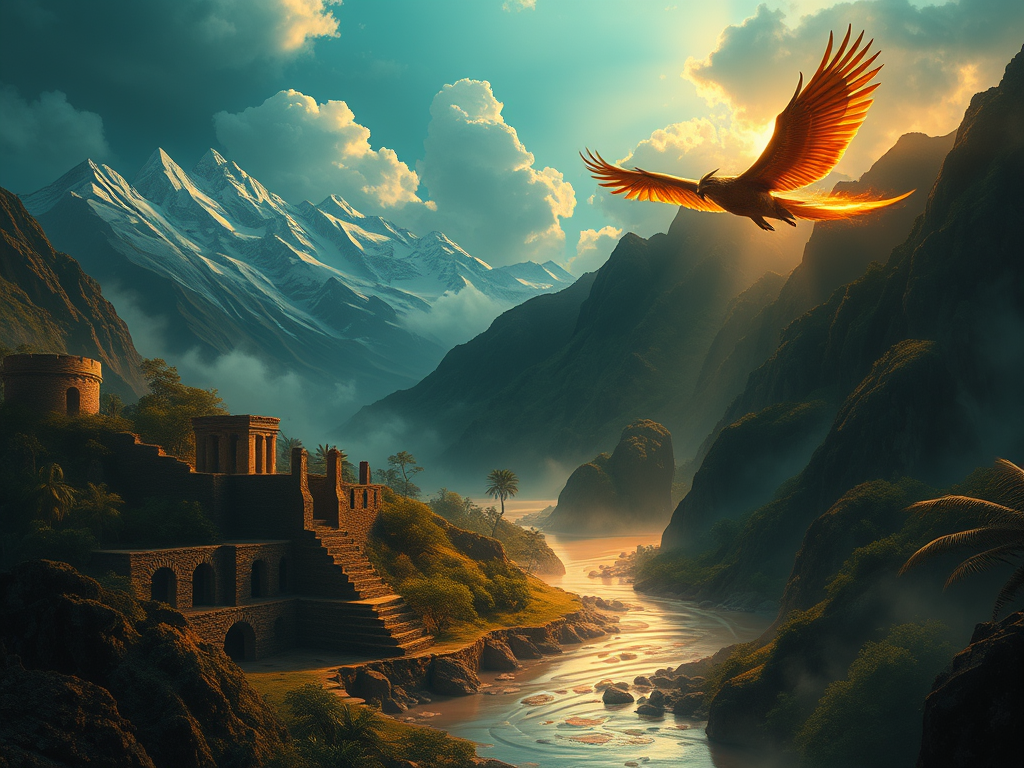

For more than three millennia, the world of Einarth thrived in the quiet of the Age of Exploration. From his seat in the heavens, the Creator, Bhava, watched as the four original mortal races—the graceful Elves, the resilient Dwarves, the ambitious Humans, and the nature-bound Rith’yar—spread across the lands he had shaped. He had granted them dominion over the earth and the sea and then stepped back to let them build their own destinies.
Bhava watched with a mixture of curiosity and affection as the mortal races adapted to their environments and coexisted in harmony. The Elves settled the ancient forests of Eskandor; the Dwarves carved the deep holds of Haalmdor; the Humans spread their realm of Norstok across the Keracin Plains and beyond; and the Rith’yar found their home in the lush Jungaran Peninsula. It was a time of discovery where the mortal races altered their environments and built great societies without direct divine interference.
The Age of Divines
As Bhava watched his beloved creations he began to experience a deep loneliness. Bhava gloried in their ability to adapt, yet as the centuries stretched into millennia, the silence of the heavens began to weigh upon the Creator. The distance between the creator and the created became an unbearable burden. He felt a profound need to intimately know and deeply love the beings he had dreamed into existence. This divine longing served as the catalyst for the Age of the Divines, an era that began when Bhava chose to leave his heavenly abode and descend to live directly among the mortals. He did not arrive with a display of terrifying power; instead, he appeared in many humble forms—as a wandering storyteller, a wise teacher, or a helpful stranger—so that he might, once again, walk the roads of Einarth as one of his own.
Symbology & Teachings
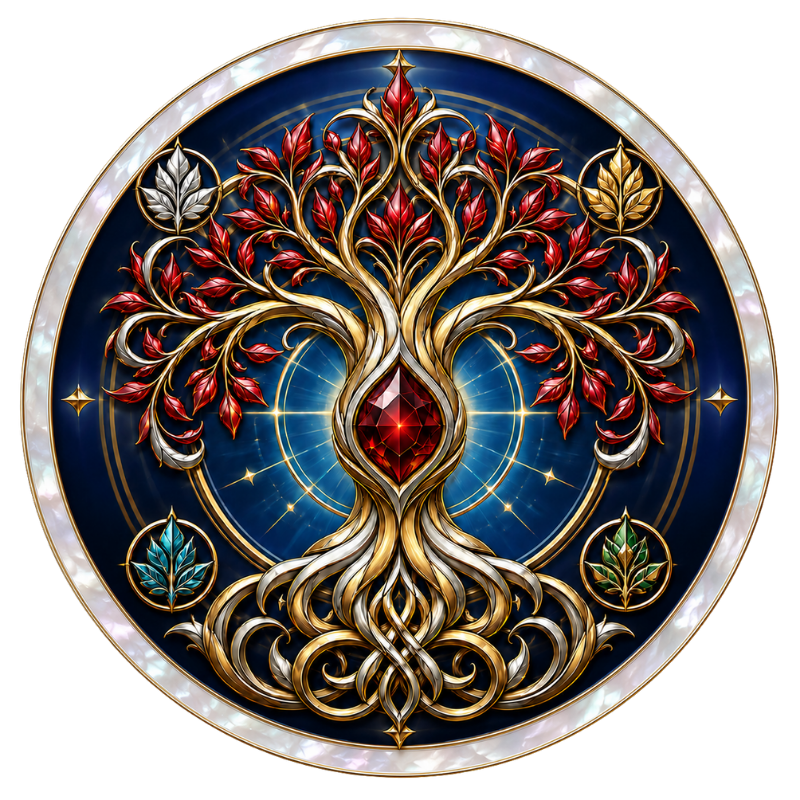
During this intimate era, Bhava’s presence was symbolized by the Spirot Tree, representing growth and the interconnectedness of all life. The Garnet, became synonymous with his passion for creation and the depth of his wisdom.
Bhava taught dominion as stewardship, not ownership. He asks mortals to build, dream, endure, and remember; to treat land, beasts, harvest, and neighbor as trusts rather than possessions; and to resolve disputes through hospitality, ritual, and patient negotiation before violence.
Immortal Offspring
His time among mortals was not merely one of teaching; it was one of deep connection and love. He formed numerous affairs with mortals from each of the original races, choosing those whose wisdom, skill, or courage caught his attention and his heart. From these unions, twelve the lesser gods were born, each carrying a spark of their father’s divine essence shaped by their mortal heritage.
As we look back from the current Age of Heroes, the Age of the Divines stands as a bittersweet memory of a time when the Creator’s love was a physical presence in the world. It was an age where the divine and the mundane walked hand-in-hand, but it was also the beginning of the end for the world’s initial innocence. The introduction of divine power into mortal bloodlines would eventually lead to the wonders of the Age of Magic, but it also planted the seeds of the Age of Chaos.
Next week, we’ll begin our exploration of these divine children, starting with the birth of the firstborn of the Divines—Omerus, the god who would bridge the gap between divine origin and mortal understanding, and bring the first spark of magic to the realm.
Leave a Reply