

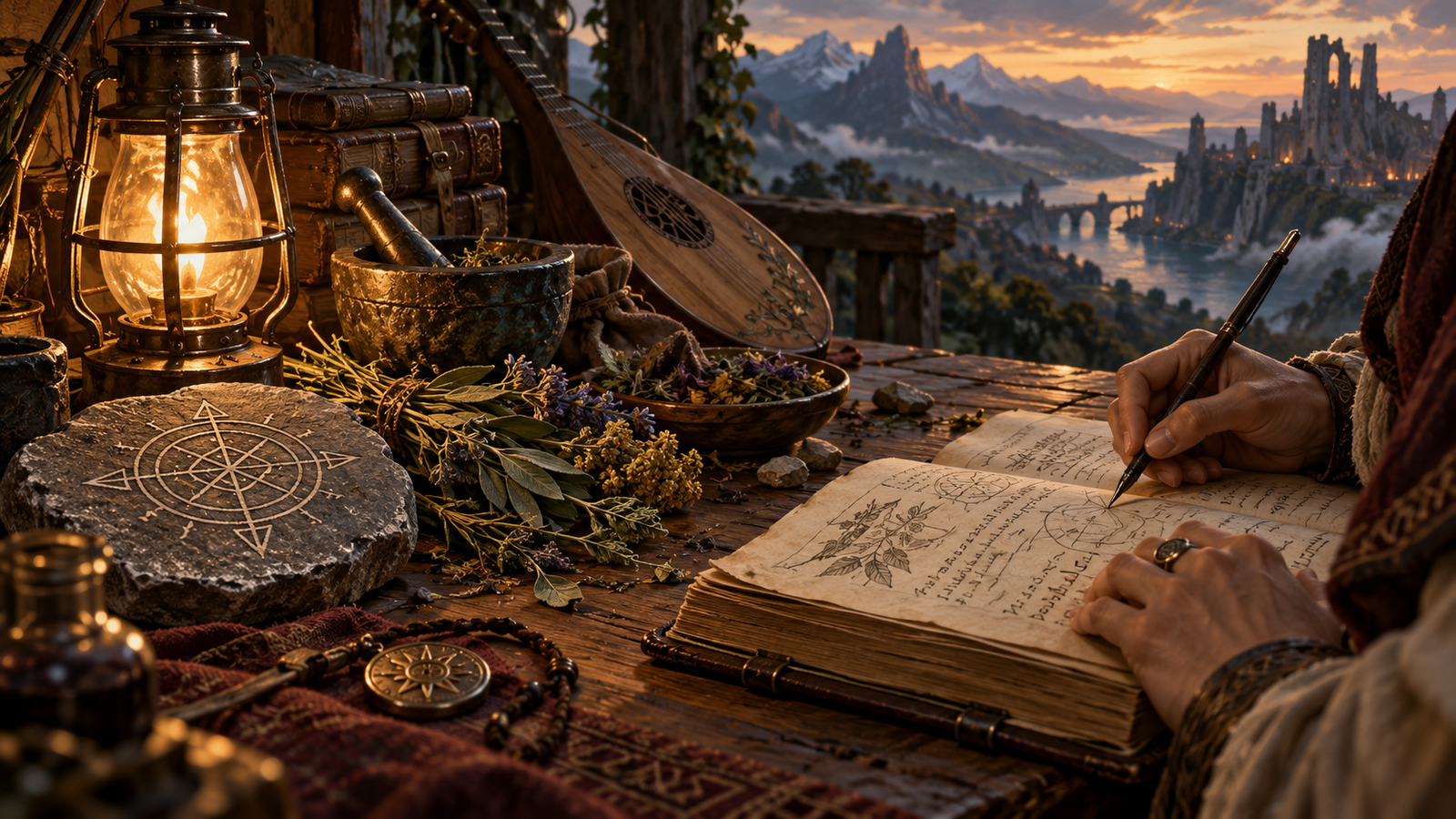
The first magical traditions of Einarth were not created in grand academies.
Most began because someone needed something to work twice.
A song that soothed fear was remembered. A mark that held against danger was copied. A prayer that seemed to protect a was spoken again the next night. Healers began repeating the same motion over fevered children. A warning about a poisoned grove became part of what the next generation was taught.
That is how scattered experience began to become knowledge.
The Elves had time on their side. They studied changes in perception, foresight, and the strange relationship between magic, the stars, and time.
Their understanding did not arrive all at once. It accumulated.
Dwarven magic developed in a different way. Dwarves carved, struck, tested, rebuilt, and tested again. It became as much a craft as smithing or stonework. The material mattered, the depth of a carving mattered, placement mattered. A rune that worked in one kind of stone behaved differently in another.
Their knowledge survived because it could be built into things.
Humans were less patient.
They formed pushed against limits almost as quickly as they discovered them which led to many of the Age of Magic’s greatest discoveries and some of its worst mistakes.
The Rith’yar did not follow the same path as the Elves, Dwarves, or Humans. Their strength came from knowing the world around them. They developed an affinity to natural remedies, the turning of the seasons, and animals.
In an age increasingly fascinated by wonder that simple ability was easy to underestimate.
Across Einarth, people began discovering that magic could rarely be separated from method. It might require a certain rhythm, material, place, or tool. Even with success there was often a cost that had not been obvious at first.
Mortals could use power.
That did not mean they understood it.
The practices that eventually became schools, guilds, orders, and traditions began much more simply. Someone survived a failure, someone remembered what happened and someone warned the next person.
Over time, the warnings became rules.
Next week, we will look at how the creation of the Naga continued to shape Einarth long after their creation, changing borders, peoples, and the way mortals understood magic itself.
Leave a Reply