
Norstok
As the spirit of exploration yielded to permanent settlements, the landscape of Einarth transformed. Each race set about giving the land new shape—a reflection of their dreams and hands.
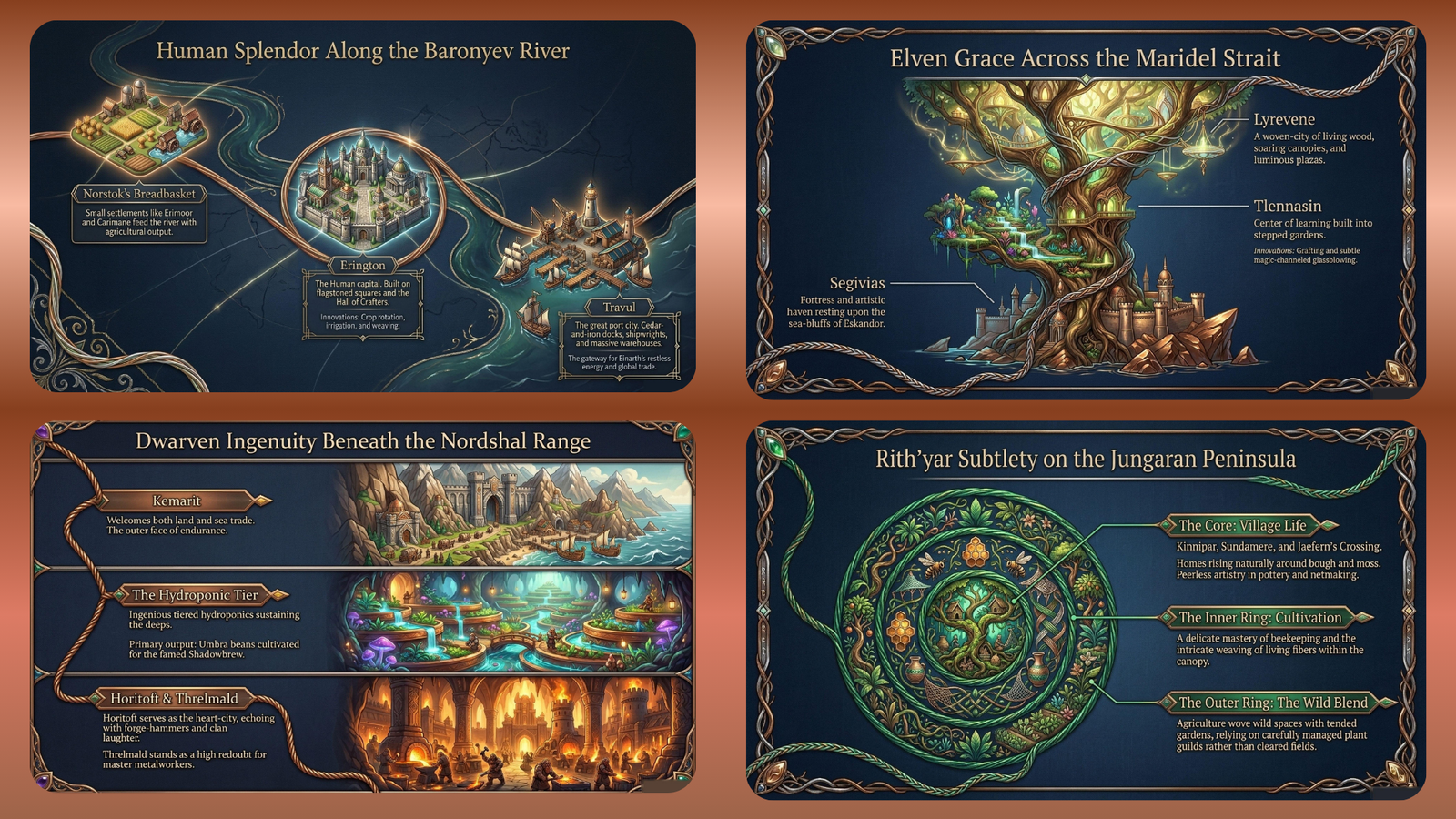
Of all the markers of this flourishing era, none shone brighter than the foundation of Erington, the Human capital. What began as a wide clearing beside a river bend grew over decades into a city of stone-reinforced walls, broad avenues, and a bustling market that never truly slept.
The heart of Erington was its flagstoned market square, lined with guildhouses and the Hall of Crafters. Here, Human ingenuity thrived—advances in crop rotation, irrigation, and weaving turned Norstok into Einarth’s western breadbasket.
Downriver lay Travul, the great port city. Its cedar-and-iron docks, warehouses, and shipwrights welcomed vessels from across the known world. Trade flowed endlessly along the Baronyev River, carrying goods, ideas, and the restless energy that defined the Human spirit.
Eskandor
Smaller settlements like Erimoor and Carimane flourished along the river, each contributing its own gifts to the growing Human lands. Human determination and adaptability raised proud cities from the wilds. Elves and Dwarves would express their own visions of civilization with equal grace and strength.
To the southeast, across the Maridel Strait, the Elves transformed the wilds of Eskandor into living works of art. In Lyrevene, they raised a woven-city of soaring canopies and luminous plazas where living wood formed halls and bridges. Brennegan became a center of learning amid stepped gardens and cliff-side galleries, while Aronov stood as both fortress and artistic haven upon rocky volcanic bluffs.
The Elves mastered grafting, living architecture, and the art of glassblowing that channeled subtle magic. Their cities breathed with beauty and harmony.
Haalmdor
To the west, the Dwarves carved their heart-city of Jarrkliff deep beneath the mountains, its vaults echoing with forge-hammers and clan laughter. Ardem rose as a redoubt of master metalworkers high in the Nordshal range, while the surface city of Kemarit welcomed trade by sea as well as land.
Dwarven ingenuity shone in tiered hydroponics, masterful stonecraft, and the famed Shadowbrew brewed from umbra beans. Their halls and roads were built to endure centuries, their craftsmanship trusted across Einarth.
Where Elves coaxed beauty from living wood and glass, Dwarves shaped endurance from stone and metal. Yet one people remained, practicing a subtler art.
Jungara
Among the Rith’yar, artistry took a gentler form. Their villages—Kinnipar, Sundamere, and Jaefern’s Crossing—blended seamlessly with the jungle. Paths wove naturally between ancient trees, and homes rose around bough and moss rather than imposing upon the earth.
They excelled in beekeeping, netmaking, pottery, and the weaving of living fibers. Their agriculture wove wild spaces with tended gardens, encouraging plant guilds that thrived in harmony. Music and story flowed as naturally as the rivers through their lands.
As each race put down deeper roots, the world of Einarth came alive with commerce and shared innovation. Markets buzzed with cross-pollination: Elven medicines, Dwarven metalwork, Human grain and dyed cloth, and Rith’yar honey and textiles.
Artisans became near-mythic figures, and festivals drew all races together. Governance, law, and mediation evolved through exchange—Humans adopted open debate, Elves embraced formal contracts, Dwarves shared their codes of honor, and Rith’yar offered gentle wisdom in mediation.
Though each people left a distinct signature upon the land, the borders between them proved more fluid than maps suggested. As the Age of Exploration drew to a close the tapestry of Einarth held colors and designs no single race could have conceived alone.
Leave a Reply